
Over the past 12 months, the federal government has executed 10 direct equity investments in commercial companies at a speed and scale that has no modern precedent. Deals that would have taken years through traditional channels are closing in months.
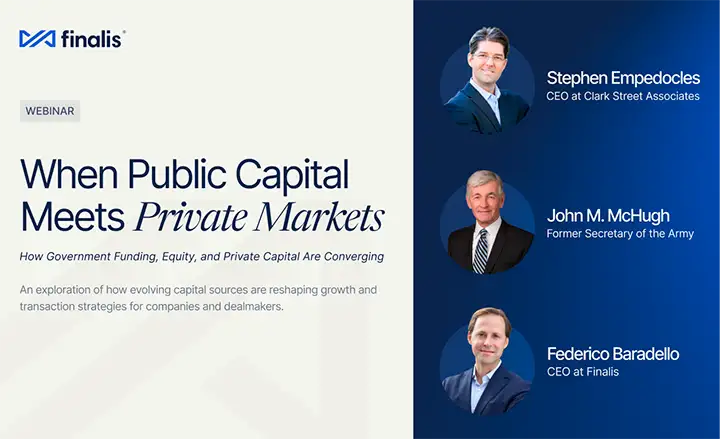
On February 19, we sat down with Stephen Empedocles (CEO, Clark Street Associates) and former U.S. Secretary of the Army John McHugh to unpack what this shift means for dealmakers, founders, and operators. Federico Baradello (CEO, Finalis) moderated the conversation.
Here's what we took away. You can watch the full recording here or read our main conclusions below.
This isn't business as usual for the federal government
Historically, the government funded corporate growth through a narrow set of tools: direct cash, loans, and loan guarantees. That's it. Equity was never part of the playbook.
What changed? According to Stephen, the current administration brought an investment banking mindset into government. The idea of taking equity positions in companies working on national security priorities makes sense for both sides, but it simply wasn't part of the traditional government thought process.
Secretary McHugh added critical context: the urgency is driven by national security. Critical supply chains, from microelectronics to rare earth minerals, were offshored over the past two decades. Equity investments offer a faster path to reshoring those capabilities than the traditional budget cycle, which can take two to three years from first pencil to disbursed funds.
The government isn't just writing checks
One of the most practical takeaways from the conversation: the federal government brings tools to the table that no private investor can match.
Stephen walked through several real examples. Trilogy Metals received a $35 million equity investment, but what moved the needle was a road the government built connecting their Alaskan mine to the rest of the world. That turned a mineral exploration company into a mining company and drove a 150% boost in market cap.
MP Materials got a 10-year, 100% offtake commitment with a price floor alongside their equity deal. What financial investor offers that?
The toolkit includes fast-tracked permitting, access to federal technology and land, regulatory relief, and offtake agreements. Stephen's advice to companies: understand what the government can offer beyond capital, because those non-financial tools can be the most impactful part of the deal.
Where the money is going
The conversation covered which sectors are attracting the most attention. So far, the bulk of investments have gone into semiconductors and critical minerals, but both speakers see the field expanding.
Stephen highlighted several areas to watch: small modular nuclear reactors and energy generation technologies (particularly those that can be co-located with data centers), grid infrastructure, commercial fusion, and AI and quantum computing infrastructure.
Secretary McHugh noted there's broad bipartisan agreement on roughly 8 or 9 critical areas. The investments so far have come through just three departments: Commerce, Energy, and Defense.
The window is open, but it won't stay open forever
Both speakers were direct about urgency. The current environment is unusually favorable for companies willing to move.
Secretary McHugh framed it simply: "The dinner bell is ringing." He emphasized that government programs never get simpler over time. Congress will eventually want a more direct voice in how these investments are structured, which means more complexity, more requirements, and more competition.
Stephen echoed this: there's effectively no competition in the equity space right now. No incumbents to unseat. The government is flexible on deal structure and relatively unburdened by red tape. His estimate: this window lasts roughly 18 to 24 months.
For companies thinking about entering this space, both speakers stressed that acting now, while the rules are still being written, gives you an extraordinary amount of influence on how deals get structured.
The biggest barrier is perception, not reality
When asked about obstacles, Secretary McHugh was candid: for companies that have never worked with the federal government, the sheer scale and complexity of it can be intimidating from the outside. But he was equally direct that it's worth engaging.
Agencies are actively trying to make the process more accessible, including the newly announced Economic Defense Unit at the Department of Defense, a $266 million initiative to coordinate capital and industrial capacity.
Stephen reframed the barrier as opportunity: the gap between the government world and the private sector world is exactly where the biggest opportunities live right now. Neither side has fully figured out how to do this yet, and that lack of clarity is what creates room.
Speed doesn't mean less diligence
A common concern is that fast-moving deals mean corners are being cut. Stephen pushed back hard on this. Based on his direct experience, the level of due diligence on current equity deals is substantially higher than what he's seen on traditional government funding that took 18 months to close.
The difference is process, not rigor. Instead of a serial chain of approvals, the government is running due diligence in parallel, more like how a Wall Street investment bank evaluates a deal. The result is faster timelines without sacrificing quality.
Know your customer
Both speakers returned to a foundational point: the government is a strategic investor, not a financial one. It invests to accomplish national security objectives, not to maximize financial return.
That means the motivations, the language, and the decision-making process are fundamentally different from what most investment bankers and founders are used to. Companies need to understand not just what the government is saying, but what it means in its own language.
Stephen's closing advice: "Know your customer. The government is a weird customer, motivated by weird things. A traditional investment banker may not care that a company helps position the United States as the global leader in AI. That may be the primary reason the government wants to make an investment."
This conversation was hosted by Finalis in partnership with Clark Street Associates. If today's conversation raised questions specific to your company or deals you're exploring, reach Clark Street at clarkstreetassociates.com or contact us to continue the conversation.
Q&A Highlights
Is direct government investment replacing traditional forms of government funding like grants and loans?
No. Grants, loans, and loan guarantees are still active and valuable. Stephen emphasized that companies should pursue non-dilutive funding in every case they can. Equity is simply a new tool the government is using, and it's often used in combination with other vehicles. The USA Rare Earth deal, for example, was a combination of equity plus loan. Other deals in the pipeline combine equity with grants or other instruments.
How closely does a company need to know what it wants before approaching the government?
Very closely, but also with an open mind. Stephen noted that companies should come into the room knowing what they need, but more importantly, knowing what they can ask for. The government's toolkit goes well beyond capital: fast-tracked permitting, offtake agreements, regulatory relief, access to federal land and technology. Most companies don't fully appreciate what's available, and that's where working with experienced advisors makes a real difference.
How fast are these deals actually moving?
Some equity investments are closing in a matter of months, compared to the 12 to 18+ months typical of traditional government funding. Stephen stressed that speed doesn't come at the expense of rigor. The due diligence on current deals is actually more thorough than what he's seen on slower, traditional deals. The difference is that the process runs in parallel rather than through a serial chain of approvals.