
AI is no longer a futuristic idea hovering at the edges of investment banking. It is already reshaping workflows, accelerating execution, and redefining how boutique firms compete. For independent bankers operating with lean teams and deep specialization, the shift is especially meaningful: AI is delivering leverage that once required large analyst benches, without sacrificing quality or control.
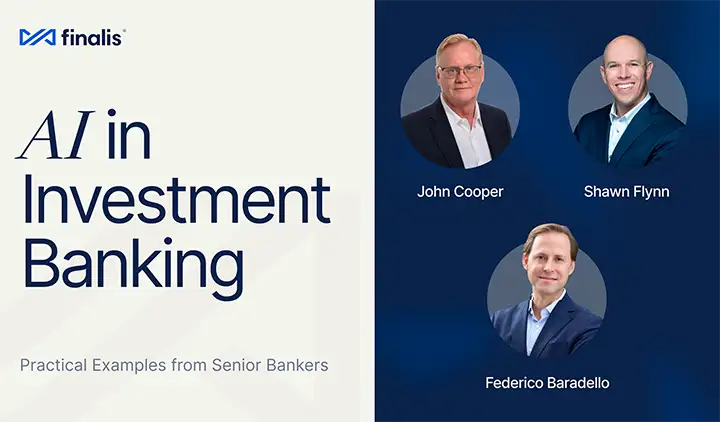
This was the core theme of The Real Impact of AI on Dealmaking, a live conversation hosted by Federico Baradello, CEO of Finalis, with panelists John “Coop” Cooper of Carlsquare and Shawn Flynn of SVH Capital. Their perspectives — one from a global mid-market platform and the other from a fast-growing boutique — reveal how AI is transforming dealmaking today, what risks firms must navigate, and where the biggest opportunities lie for 2026 and beyond.
Want to watch the full webinar? Here is the recording.
AI Is Redefining the Analyst Leverage Model
For boutique banks, the most immediate impact of AI is clear: smaller teams are doing more — much more.
Research that once took weeks can now be completed in hours. Analysts who used to spend days synthesizing public filings, generating buyer lists, or comparing CIMs to diligence Q&A can now do the same work with far greater speed. According to Coop, internal AI agents have compressed what was once eight man-weeks of research into a few hours.
Shawn echoed this shift from another angle — the productivity expectation inside a lean team:
His firm uses AI to give each person the output capacity of a multi-analyst function.
For boutique banks that pride themselves on efficiency, this is a turning point. AI is not replacing analysts but elevating them, enabling firms to scale without headcount bloat and to compete with much larger organizations.
Why Industry Expertise Now Matters More Than Deal Pedigree
Even as AI accelerates execution, human judgment, nuance, and market instincts are becoming more valuable — not less.
Shawn shared an example that illustrates this shift perfectly. His team recently hired a professional with 20 years of dental industry experience but without formal investment banking training. Traditional models would require years of upskilling. But with AI tools assisting with research, synthesis, and document preparation, her deep sector knowledge becomes immediately additive. Combined with AI-powered workflows, she can ramp up significantly faster than in the past.
For boutique firms focused on specialization — dental, healthcare, industrials, consumer services — this changes the hiring equation. AI empowers specialists to outperform generalists, strengthening the niche-focused model that defines so much of the independent banking landscape.
Human Judgment Still Wins: The ‘Sherpa’ Role of the Modern Banker
Despite technological leaps, the role of the banker remains fundamentally human.
Clients do not choose a firm because of its AI stack. They choose the banker who can interpret complexity, build trust, and guide them through a moment that often represents the culmination of a lifetime of work. AI can generate insights, surface patterns, or improve preparation, but it cannot sit across from a founder and understand what matters most to them.
This is why Coop emphasized the importance of keeping a human in the loop, and Shawn pointed out that clients care far more about whether you can “get them to the finish line” than about how your internal engine operates.
The “modern investment banker” is therefore a blend:
tech-enabled, highly mobile, insight-driven — and relentlessly human.
Real Examples of AI Creating ROI in Deal Workflows
Across both firms, several use cases show immediate and measurable value:
1. Faster synergy modeling
AI parses filings, product documentation, and internal notes to generate buyer rationales and synergy hypotheses in hours rather than weeks.
2. Rapid Q&A response in diligence
Answering two dozen buyer questions no longer requires days of manual document review. AI can find relevant answers across CIMs, models, emails, and notes in a fraction of the time.
3. Smarter visual materials development
Bankers are using AI tools to generate visual drafts for pitch decks and CIMs before handing them off to designers — reducing iteration time and improving clarity.
4. Better preparation for management and buyer meetings
Audio briefings created with tools like NotebookLM allow bankers to absorb complex information while driving, working out, or commuting — improving retention and meeting performance.
These efficiencies compound across a full process, giving boutique banks faster momentum in competitive situations.
Where Bankers Must Be Careful: Compliance, Accuracy, and Data Risk
While AI is unlocking tremendous leverage, it also introduces risks that boutique firms must manage thoughtfully:
1. Mathematical inaccuracies
AI models still struggle with financial math and multi-step calculations. Any output involving numbers must be double-checked manually.
2. Over-reliance on generated text
Early adopters reported cases where analysts pasted AI-generated content directly into emails or CIMs without validating sources or accuracy. Firms must reinforce review discipline.
3. Transcript and communication storage
Banks increasingly use AI notetakers in diligence calls, internal discussions, and buyer meetings. But once transcripts exist, they may fall under recordkeeping rules — requiring secure storage and compliance oversight.
4. Data leakage risk
AI tools should never be used in a way that exposes confidential information to public models. Enterprise-grade or closed systems are essential.
The takeaway: AI amplifies both good process and bad process. Clear guidelines and human review are non-negotiable.
What Tools Should Boutique Banks Bet On?
The panelists identified three categories that matter most for 2026:
Vertical AI platforms for banking
Tools focused specifically on investment banking workflows — synergy modeling, comp scraping, deck drafting, Q&A acceleration — are improving rapidly.
Horizontal LLMs with financial capabilities
Enterprise versions of Claude, Gemini, and OpenAI offer broad flexibility for drafting, research, summarization, and scenario analysis.
AI-enhanced versions of tools bankers already use
PitchBook, Bloomberg, and CapIQ are now layering AI onto their existing datasets — likely to become foundational for many banks.
Both Coop and Shawn discouraged “tool-hopping.” Instead:
Choose a stack that integrates cleanly into your firm’s workflow and aligns with your team’s skill set.
Closing Thoughts: The Boutique Firms Who Embrace AI Thoughtfully Will Win in 2026
The message was clear: AI is not replacing bankers — it is empowering them.
For independent investment banks, this moment is a rare advantage. AI allows small, specialized teams to:
• operate with the leverage of much larger firms
• deliver faster, more defensible insights to clients
• focus more time on human relationship-building
• compete effectively in crowded processes
• differentiate through both technology and specialization
The firms that approach AI thoughtfully — with strong processes, compliance awareness, and a focus on human judgment — will lead the next chapter of dealmaking.
Ready to modernize your deal workflow?
Finalis helps investment banks close deals 20% faster, operate safer, smarter, and more profitably — all with compliance at the core.
Want to explore how Finalis can support your firm?
Contact us today.
Frequently Asked Questions
How is AI changing investment banking at boutique firms?
AI tools are changing how boutique investment banks handle document-intensive and data-heavy workflows: due diligence document review, financial model checking, engagement letter analysis, and deal sourcing from public databases. According to McKinsey & Company, generative AI has the potential to automate significant portions of work in financial services, particularly in knowledge-intensive tasks. For boutique firms with lean teams, this creates an opportunity to handle deal volume that would previously have required larger headcount.
What specific tasks in M&A dealmaking can AI assist with?
AI tools can assist with document review and extraction during due diligence (reviewing contracts, identifying key terms and exceptions), financial model checking, drafting sections of CIMs and pitch materials, analyzing comparable transactions from public databases, and reviewing engagement letters for standard or non-standard provisions. These are tasks that traditionally require significant associate-level time. According to Deloitte, AI-driven automation in banking workflows is most effective when applied to structured, repetitive analysis rather than high-judgment client interactions.
Can AI replace investment bankers?
AI tools automate specific workflows — document review, data extraction, pattern recognition — but the core of investment banking involves judgment, relationships, and negotiation that AI does not replace. Bankers who understand how to use AI tools efficiently can increase their throughput; bankers who ignore them risk falling behind peers on execution speed. The opportunity is augmentation, not replacement.
How should boutique investment banks evaluate AI tools for deal workflows?
Boutique firms should evaluate AI tools on several dimensions: accuracy and reliability on the specific task (document review, financial analysis, or drafting), data security and confidentiality practices, integration with existing deal management workflows, and the licensing and pricing model. According to KPMG, financial services firms evaluating AI tools should conduct structured pilots before broad deployment, particularly for tasks involving client data.
What compliance considerations apply to AI use in investment banking?
Investment bankers using AI tools to prepare client communications, pitch materials, or research must ensure that AI-generated content meets the same regulatory standards as human-prepared content. Under FINRA Rule 2210, all communications with the public must be fair, balanced, and not misleading, regardless of how they were generated. Principal review requirements apply to AI-generated marketing materials the same way they apply to materials prepared by a human.
How are AI tools changing due diligence in M&A transactions?
AI-powered due diligence tools allow deal teams to process large volumes of contracts and documents faster than manual review. These tools extract key terms, flag non-standard provisions, and summarize document sets in ways that previously required extended associate time. According to PwC, AI-assisted due diligence is one of the highest-ROI applications of generative AI in financial services because the time savings per deal are meaningful and the task structure is well-suited to pattern recognition.
What do boutique investment banks need to do to prepare for AI-driven change?
Boutique firms that want to use AI effectively need to invest in three things: understanding which workflows are genuinely amenable to AI assistance (not all are), establishing data security and confidentiality protocols for any tools that handle client information, and building their bankers’ ability to evaluate and correct AI outputs rather than accept them uncritically. Firms that adopt AI tools selectively and thoughtfully gain workflow efficiency; firms that adopt them indiscriminately create new risk.