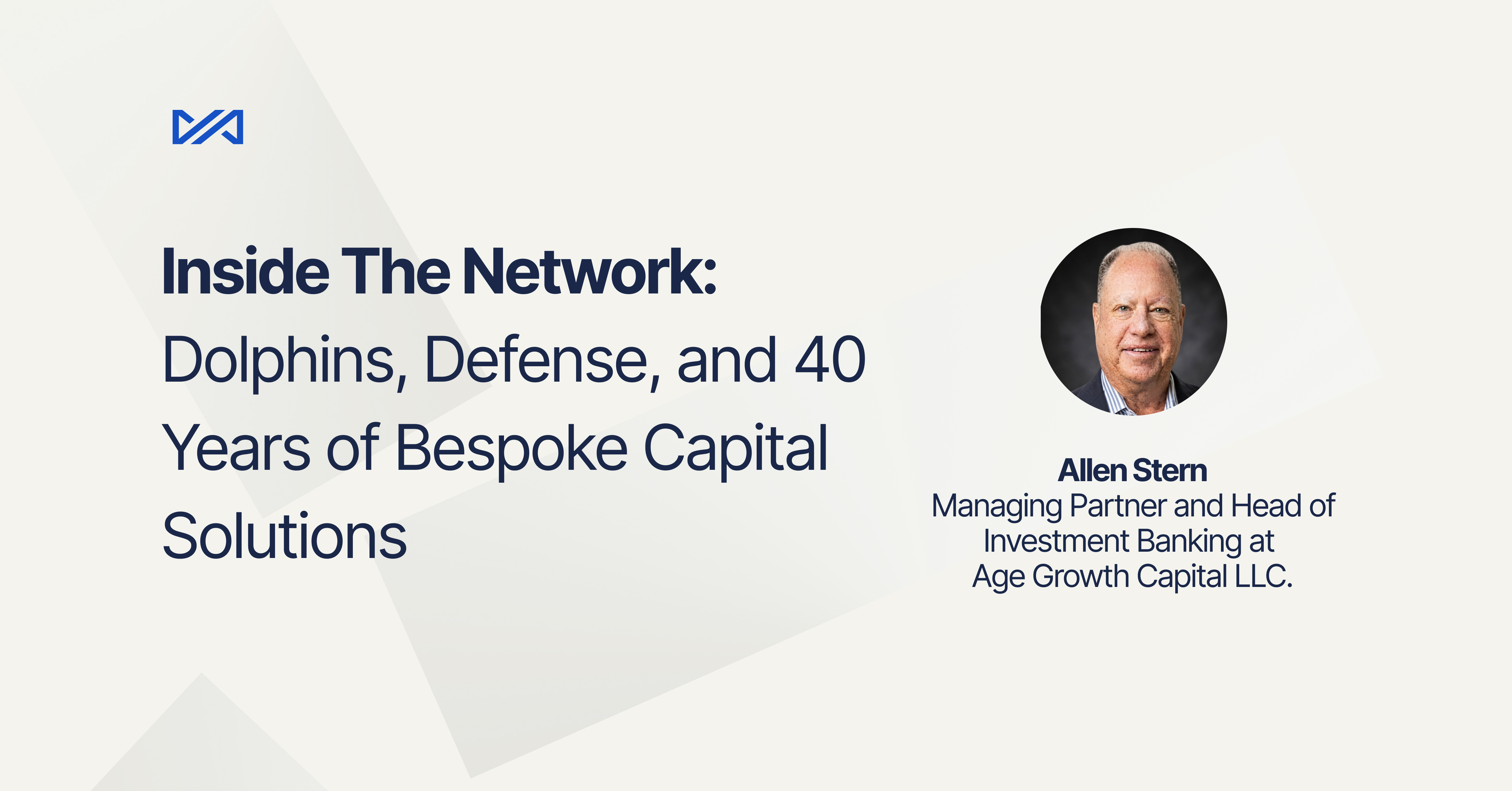

In this edition of Inside The Network, we sit down with Finalis member Allen Stern, Managing Partner and Head of Investment Banking at Age Growth Capital LLC.
Allen has spent more than 40 years structuring capital for lower middle market companies, from the high yield desks of the 1990s to today's defense technology sector. We talked about his journey, the deal he's proudest of (yes, it involves dolphins), and why the companies that need bankers most are often the ones big banks pass over.
From Drexel to the Lower Middle Market
Allen started his career as a commercial banker in Boston, taking the shuttle to New York to call on private equity firms like KKR and Blackstone. Today that work goes by the name sponsor coverage.
At the time, he was watching Michael Milken and Drexel Burnham Lambert build the high yield bond industry from the ground up. When Drexel closed its doors in 1990, Allen moved his young family 3,000 miles to Beverly Hills to join a group of former Drexel executives who had run the firm's high yield trading desk.
He became a partner, and over the next 32 years the team grew the firm to about 300 employees and 9 offices around the world.
“We really dominated the lower middle market high yield bond and debt placement space,” Allen says.
A Second Act at Age Growth Capital
After more than three decades building that firm, Allen tried retirement. It didn't stick.
“I tried to retire for two months and almost lost my mind,” he says.
That's when he met his current partners: two brigadier generals who retired after 30-year careers in the Air Force. They had started a consulting company retained by the Department of War to find advanced technologies that support warfighters. In just 5 years, they've arranged over $800 million for about 180 companies.
Many of those companies also need private capital, debt and equity, beyond what government funding covers. That's where Age Growth Capital comes in.
Today, about 50% of the firm's engagements are in aerospace, defense, and security. As a generalist, Allen also works across business services, consumer, and other sectors. For him, the defense work carries a different kind of meaning.
“We're making money, but we're doing good, and we're helping our warfighters,” Allen says. “I just love it. It's a sector that's going to grow, unquestionably, and it's actually a lot of fun to be a part of it.”
The Deal He's Proudest Of: Dolphins as Collateral
Asked to pick one deal from a 40-year career, Allen didn't hesitate. His favorite was a theme park operator based in Cancun, Mexico, where guests could swim with dolphins.
“When I met them, the company had six locations and about $6 million of EBITDA,” Allen recalls. “The owner wanted to expand outside of Mexico and diversify his revenue. Over a five-year period, we raised over $300 million in acquisition capital, built a portfolio of 32 parks, and took EBITDA from $6 million to $32 million.”
The acquisitions stretched across the Caribbean, Florida, Italy, and Argentina. To fund them, Allen's team arranged a private placement of 144A bonds, which he favors as flexible, long-term permanent capital, and layered subordinated debt on top. He also visited all 32 vacation destinations, strictly for due diligence.
The fundings took place on 5 continents and across 24 legal jurisdictions. Most of the deals closed before COVID, the lenders stayed supportive through the pandemic, and the team came back afterward to raise rescue and growth financing.
“I had a first-time issuer out of Mexico, which is not easy, and I had dolphins for collateral,” he says. “If I can do that deal, I can do almost any deal.”
Why the Lower Middle Market Needs Hands-On Advice
In Allen's view, the deals that sell themselves end up with the bulge brackets. The lower middle market is a different job.
“Selling stock in SpaceX is like taking orders at a bakery,” Allen says. “Our lower middle market companies really need handholding, and they need a lot of deal structuring. You really have to roll up your sleeves and give advice.”
Getting clients to the valuations they expect usually takes highly structured, bespoke transactions, and decades of knowing the tricks of the trade.
The stakes are also personal in a way that big-company deals rarely are.
“If a Fortune 500 M&A deal doesn't get done, both of those CEOs are still going to eat steak and go on vacation,” he explains. “For the folks we're advising, it's their life's work.”
Whether it's a sale or a capital raise to buy a competitor and scale, Allen sees it as one of the biggest trades of his client's life. “It's a big responsibility, and I take that responsibility very seriously.”
The Market Ahead
AI: Smaller, Faster, Cheaper
Allen sums up AI's effect on dealmaking in three words. At his former firm, the bullpen had 20 junior analysts. Today, one analyst using AI can do the work of three or four.
“Fewer analysts, better access to data, and it saves time and money,” he says. “Being an independent banker, an independent firm, is easier today than it would have been five years ago.”
The DIY Trap
The same tools have a downside. A business owner can now pull together a list of lenders or private equity firms on their own and decide they can run the process without an advisor.
“They think they're going to save an investment banking fee,” Allen says. “They save a million dollars, and they leave 5 to 10 million on the table.”
Allen tells prospective clients to think of a banker as an insurance policy. “In my 40 years, I've never not paid for myself.”
Plenty of Business for Everyone
As baby boomers age, Allen expects a wave of exits, with more money flowing into private markets to meet them.
“I think there's going to be plenty of business for everyone,” he says. “It's a great industry to be in.”
What Allen Brings to the Network
Allen describes Finalis as plug-and-play infrastructure built for independent investment bankers, one that gives him room to spend his time where it counts.
“Finalis lets me focus on clients, not compliance,” Allen says. “I love that.”
That focus shows in what he brings to the rest of the network. Over four decades, Allen has built deep expertise in debt capital and non-control equity solutions, from high yield and 144A private placements to layered subordinated debt and rescue financing. The dolphin park deal is one example of how far that structuring can stretch.
The other piece is harder to replicate: relationships.
“What's irreplaceable is my 40 years of relationships with very differentiated pockets of capital, from hedge funds to family offices,” he says.
Through Age Growth Capital's sister company, Allen also works with a growing number of aerospace, defense, and security companies, many of which will eventually need M&A advice. That makes him a natural partner for members working on capital raises, and for those with M&A expertise in those sectors.
“My door is open,” Allen says. “If any of my partners on the Finalis platform would like to have a conversation about how we could collaborate, I'd love to do it.”
Quick Takes
One tool he can't live without: His relationships and his team. “I've got a great team behind me.”
A book he recommends: The Speed of Trust by Stephen M.R. Covey. It's a lesson Allen says he lives by. “My team and my clients never doubt where I'm coming from, how I'm thinking, or my integrity.”
Advice for anyone considering this career: “It's never the perfect time to go independent. Don't spend too much of your career working for the man. Believe in yourself, have confidence, and go for it.”
Conclusion
Allen Stern's career runs from the early days of the high yield market to the current wave of capital moving into defense technology. The constant through all of it is bespoke structuring for companies that big banks pass over, and a personal sense of responsibility to the owners behind them.
His story is also a reminder of how experience compounds. Forty years of relationships, structures, and hard-won lessons only gain value as the market grows and the tools get faster.
We're glad to have Allen and the Age Growth Capital team in the Finalis network.